
Virtual sensors that know your process
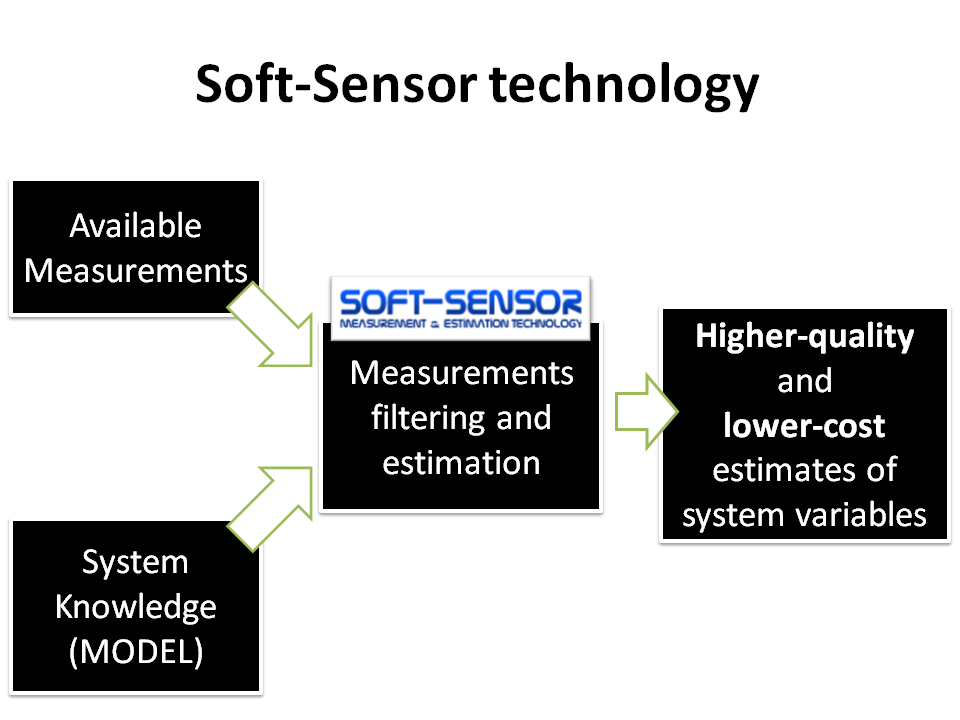
Virtual sensors — also called soft-sensors — combine system knowledge with available measurements to deliver reliable estimates of variables that are expensive, inaccessible, or impossible to measure directly.
What Are Virtual Sensors?
A virtual sensor — also called a soft-sensor — uses a mathematical model of the process together with existing measurement data to compute an estimate of a variable of interest. Unlike a physical instrument, a virtual sensor or soft-sensor requires no additional hardware: it runs as software on existing control systems, exploiting the instrumentation already in place.
Industry Problems Solved
Measurement is too expensive
Analytical instruments for quality, viscosity or composition cost €50k–€500k and are shared across streams — giving only periodic samples, not continuous data.
A virtual sensor delivers continuous estimates between analyzer samples, enabling tighter real-time control.
Instrumentation cannot be installed
Flow meters at valve locations, heat loads in cryogenic circuits, or torque in sealed drives cannot be instrumented due to cost, space, or harsh conditions.
A virtual sensor computes the variable from correlated upstream/downstream measurements already present in the system.
No direct measurement exists
Variables such as polymer melt index, cell concentration, or catalyst activity have no real-time in-line sensor technology.
A virtual sensor infers these variables from measurable proxies — temperature, pressure, flow, spectroscopy — using first-principles or data-driven models.
Sensor failure and redundancy
Critical measurements fail during startup, upset, or fouling. A single point of failure in a safety-critical loop cannot be tolerated.
A virtual sensor merges redundant measurements from multiple instruments to provide a fault-tolerant estimate that remains valid when individual sensors fail.
Measurement accuracy
Two instruments measuring the same variable may have complementary accuracy profiles — one fast but noisy, one slow but precise.
A virtual sensor fuses both signals using optimal estimation theory to produce an estimate that is simultaneously fast, precise, and drift-free.
Technology
Measurements
The exact sensor requirements are determined case by case. In most cases, existing instrumentation is sufficient — no new hardware is needed.
Models
Models encode the system knowledge exploited by the virtual sensor. Complexity ranges from simple empirical correlations to full thermo-hydraulic or kinetic dynamic models. We specialise in first-principles modelling for process industry and aeronautical applications.
Estimation Algorithms
From linear observers (Luenberger, Kalman Filter) to nonlinear algorithms (Extended Kalman Filter, Unscented Kalman Filter, Moving Horizon Estimation). The choice depends on the degree of nonlinearity, available compute, and required accuracy.
Measured Results
- LHC cryogenic circuit (CERN): 5 thermodynamic states estimated in real time from 3 pressure sensors + temperature — nonlinear MHE at 1 Hz for superfluid helium below 2 K.
- Virtual flow meter at valve locations: continuous flow estimate without physical flow meter installation, reducing per-point instrumentation cost to software only.
- Sensor fusion variometer (SSDV12): pressure + IMU + GPS fusion delivering climb-rate resolution and accuracy beyond conventional barometric variometers.
- Analyzer gap coverage: continuous virtual sensor quality estimate between 2-hour laboratory sample intervals, enabling real-time quality control without additional analyzer investment.
Virtual Sensor / Soft Sensor vs Physical Instrument
A direct comparison for procurement and feasibility decisions.
| Aspect | Physical Instrument | Virtual Sensor / Soft Sensor |
|---|---|---|
| Upfront cost | €50k–€500k per instrument | Software only — runs on existing DCS/PLC |
| Installation | Weeks to months (civil works, cabling) | Days to weeks (model integration) |
| Maintenance | Calibration shutdowns, fouling, replacement | Model update — no process downtime |
| Coverage | One physical location per device | Any variable reachable by the model |
| Data rate | Periodic (analyzer: 1–2 h) or single point | Continuous, synchronous with control cycle |
| Failure mode | Hard failure — loop goes open | Graceful degradation — model-only fallback |
Products
Advanced Virtual Flow Meter
Software-based flow calculation at valve locations using valve position, pressure and temperature measurements — no physical flow meter required.
Learn moreDigital Variometer SSDV12
High-precision climb/descent rate sensor for paraglider pilots using virtual sensor data fusion of pressure, inertial and GPS measurements.
Learn moreReferences
- Non-linear Moving Horizon State Estimation and Control for the Superfluid Helium Cryogenic Circuit at the Large Hadron Collider — IFAC, 2015. Dr. Noga contributed to this work during his PhD at CERN.
Selected Publications
Peer-reviewed research on virtual sensor and soft-sensor methods applied in industrial and scientific projects.
Frequently Asked Questions
What is a virtual sensor?
A virtual sensor (also called a soft-sensor) computes estimates of hard-to-measure process variables using a mathematical model and existing instrumentation. No new hardware is required.
Is a virtual sensor as reliable as a physical instrument?
For well-modeled processes with good instrumentation, a virtual sensor can match or exceed analyzer accuracy — and provides continuous data rather than periodic samples. The CERN LHC application estimated 5 thermodynamic states in real time from 3 pressure sensors.
What hardware do I need?
No additional hardware. Virtual sensors run as software on your existing DCS, PLC, or edge computer, using signals already available in your control system.
How long does implementation take?
Typically 4–12 weeks from project start to commissioning, depending on model complexity and data availability. A 30-minute feasibility call is enough to scope the work.
Discuss Your Measurement Challenge
Every virtual sensor project starts with understanding your process, instrumentation, and what you need to measure. A 30-minute call is enough to assess feasibility.
About
Virtual-Sensor is a specialised engineering practice led by Dr. Rafał Noga — APC/MPC consultant with experience in virtual sensor and soft-sensor development for process industry, cryogenics, and aeronautics since 2007.